The Conradian Review
By Andrew Purssell, London
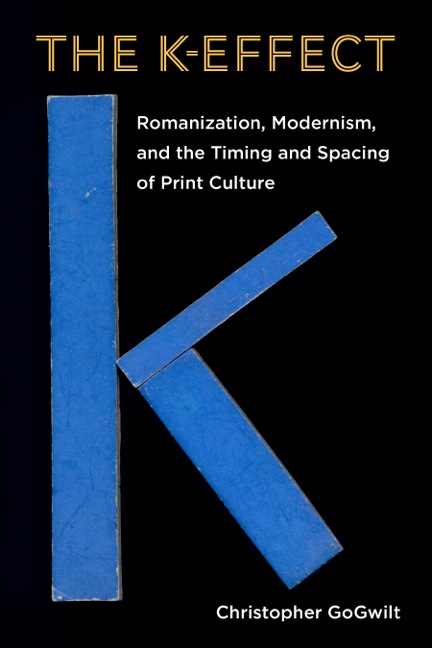
Christopher GoGwilt. The K-Effect: Romanization, Modernism, and the Timing and Spacing of Print Culture (New York: Fordham UP, 2024). 235pp.
The final pages of A Personal Record (1912) see Conrad revisiting what remains for him a foundational moment of ‘first contact’: ‘There are ships I have met more than once and known well by sight, whose names I have forgotten, but the name of that ship seen once so many years ago in the clear flush of a cold pale sun rise I have not forgotten. How could I – the first English ship on whose side I ever laid my hand! The name – I read it letter by letter on the bow – was James Westoll. Not very romantic you will say … To me the very grouping of the letters is alive with the romantic feeling of her reality as I saw her floating motionless, and borrowing an ideal grace from the austere purity of the light’.
As ever with Conrad, there is quite a lot to pick out here. That he has, in fact, if not ‘forgotten’, then at least altered, the name of this particular English ship (the real-life James Mason) raises a familiar suspicion of literary autobiography and its claims to truthfulness and authenticity; namely, that the author has not entirely stepped out of the role of ‘author’. Of course, those without even a passing knowledge of nineteenth-century nautical registers (most of Conrad’s readers, for instance) would probably already be alert to such a possibility, given that Conrad’s romanticisation of this encounter – with the British Merchant Service, and with ‘Britain’ by extension – is patently calibrated to appeal to his growing domestic audience.
In his new study, The K-Effect: Romanization, Modernism, and the Timing and Spacing of Print Culture, Christopher GoGwilt suggests another angle of approach. The K-Effect is not simply interested in the relationship between writing and identity. It is also profoundly interested in the representation of writing and of written textuality in the literary text; in other words, in the seemingly innocuous sort of detail that Conrad actively foregrounds in this passage: the ‘very grouping of letters’ that are imprinted ‘letter by letter on the bow’ of the ship, and reinscribed in the text: ‘James Westoll’. GoGwilt refers to these points where the narrative foregrounds the linguistic and alphabetic materials of its own construction as ‘chronotopes’ (after Mikhail Bakhtin), which, according to GoGwilt, ‘reflect ironically on the English print form that is the medium of Conrad’s own novelistic practice’. More on this in a moment.
The K-Effect recalls GoGwilt’s important 1995 study, The Invention of the West: Joseph Conrad and the Double Mapping of Europe and Empire, in terms of how it similarly locates Conrad and his works at a specific historical turning point. In The Invention of the West, that turning point, as the title suggests, is the modern emergence of the ‘West’ as a cultural concept and geopolitical formation during the late nineteenth and early twentieth century. In The K-Effect, it is the global turn towards ‘romanization’ – ‘simply put, the phenomenon of writing or printing something using roman letters’ – over roughly the same period, through which the Latin alphabet became the dominant writing system of global modernisation, first as an instrument of high colonialism and late capitalism, and then as the eventual basis for digital script.
The Invention of the West saw in Conrad’s works the coming together of two distinct discourses: the ‘new imperialism’, which gave greater currency to the discursive opposition of ‘East’ and ‘West’, on the one hand; and the influence of Russian debates on the Western European idea of ‘Europe’, on the other. Conrad seemed ideally positioned to help chart this literary critical ‘double mapping’ as someone whose works are frequently drawn to empire and revolution, and as a former subject and servant of both Russian and British imperialism.
The K-Effect posits a similar double-movement. GoGwilt writes: ‘Romanization may seem to involve, primarily, the imposition of European forms of language, script, and identity in the service of colonization. Yet it also involves the contest and decolonization of European forms from the perspective of non-European languages, scripts, and identities. Romanization, usually considered synonymous with the imposition of European culture on the rest of the world (“Westernization”), may, in fact, constitute the opposite – the reconfiguration and dissolution of European cultural forms within non-European, non-Western frames of reference.’ Whereas Invention is about the discursive construction of ‘the West’, The K-Effect – which considers the colonizing effects and postcolonial reinventions of language in modern print culture – is about the building blocks of discourse itself.
Conrad is, as GoGwilt asserts, again ideally positioned to help chart these linguistic twists and turns: ‘Conrad’s fiction invokes a range of different areas where romanization reforms were either enacted or attempted: Britain and the United States (debates about script standardization); Central Europe and Central Asia (with Cyrillization and romanization); Southeast Asia (the shift from jawi or Arabic to rumi or roman script); and China (where multiple script reforms preceded the formation of the current pinyin romanization that coexists with standard, simplified, written Chinese characters).’ That intriguing title-phrase, The K-Effect, is inspired by the common utilisation of the letter ‘K’ in the translation of foreign words and foreign scripts into Standard English, including words and terms encountered through the circuits and contact zones of empire (for example, ‘kadi, Kalmuk, Khan, kloof, Koran, kris’).
This practice in turn speaks to the long history of romanization in Britain: although the Latin K (which itself derives from the Greek Kappa) is eventually displaced in medieval English by the more commonly used letter C, K is retained for the transcription and transliteration of ‘Greek and other foreign words’, a rationale that remains more or less unchanged in Conrad’s contemporary moment. The letter K serves to domesticate, by rendering legible, the foreign and unfamiliar, while still distinguishing it as alien and other. Conrad himself exemplifies the lingering cultural biases of romanization, as GoGwilt suggests, through ‘his transformation from Józef Teodor Konrad Korzeniowski into Joseph Conrad’.
The K-Effect delves into the multilingual nature of Conrad’s represented Eastern and Western worlds. Conrad’s fiction registers an almost bewildering variety not only of different languages, but also their different scripts, which then cross over into the same reading experience. GoGwilt argues that these patterns are in place from the very beginning, in the opening words of Conrad’s first novel, Almayer’s Folly (1895), ‘Kaspar! Makan!’:
It is a simple piece of dialogue, introducing the first name of the title character (Kaspar) through the voice of his wife calling him to dinner (‘makan’ is the Malay word for ‘to eat’). But the effect of these opening words is far from simple, introducing a problem of translation (from the Malay) and a vexed colonial relation (between the European Kaspar Almayer and his unnamed Sulu wife who is calling him to dinner) … over the course of the novel the reader will be able to measure (at least some of) the ironies implied by the colonial relation of European to Malay, prefigured by that opening call.
The point to make, of course, is that Mrs Almayer ‘is not using the honorific title of respect, “Tuan”, for her European husband’; the colonial relation of European to Malay is revealed through a gap in the text, a missing word. This relation is also discernible in what happens to the ‘half obliterated words, “Office: Lingard and Co.”’, which signal the faded reality of Almayer’s dreams of economic empire, and which are eventually overwritten in Chinese script: by the end of the novel, Almayer’s ‘folly’ has become the ‘House of heavenly delight’. According to GoGwilt, such moments are of a piece with the novel’s subtly subversive opening call to dinner, because they ‘ironize assumptions about the ascendancy of roman alphabetic writing systems’ as being synonymous with European colonial mastery. It is a striking argument. It also typifies The K-Effect’s style of analysis, through which big claims are frequently based on fairly small bits of textual evidence.
Throughout, The K-Effect is interested in the ways in which political contest is often also a contest between opposing print cultures. Conrad’s own biography is inscribed with the clash between different writing systems. The K-Effect carries a fascinating discussion of how language policies and scriptorial reforms are deeply embedded in the history of the Polish rising of 1863 and its aftermath, as an inseparable part of ‘Russification’. This includes the Lithuanian press ban of 1865, which sought to diminish Polish influence by limiting publications using roman script while encouraging the use of Cyrillic; and how the move to standardize Ukrainian script along Russian orthographic lines was motivated, in no small part, by the perceived link between Ukrainian and Polish nationalisms. What Conrad describes as ‘the oppressive shadow of the great Russian Empire’ is, if anything, in this context a colossal understatement. For GoGwilt, Conrad’s great political novel Under Western Eyes (1911) addresses, and arrests, this linguistic direction of travel through the narrative conceit of a Russian document that has been translated from the ‘cabalistic, incomprehensible’ Cyrillic (as the narrator puts it) for an English readership. It is a victory of romanization over Cyrillization.
Whereas Russification saw the suppression of ‘nationalist’ orthographies such as Polish roman script, other countries were moving in the other direction. The K-Effect highlights the modern spread and influence of romanization, including Turkey’s shift away from Perso-Arabic script during the late 1920s as part of a deliberate policy of ‘Westernization’; and the more gradual (but no less political) conversion from Arabic script (jawi) to roman script (rumi) in post-war Indonesia. It also considers how China was looking to roman script as a means of adapting to new technologies of writing such as the typewriter and computer (at around the same time, incidentally, as the spread of new media – telephony, radio, film and television – saw the primacy of written textuality itself suddenly thrown into question).
GoGwilt sees echoes of this linguistic ‘effacement’ in Conrad’s Malay fiction, through the peripheral status of its many Chinese characters – from the coolies in Typhoon (1902) to the ‘inscrutable’ Wang in Victory (1915). Others might less charitably view these representations as more straightforwardly Orientalising (as GoGwilt appears to acknowledge). The ‘vanishing’ Wang also points to something hidden in plain sight in Victory, and throughout Conrad’s Malay fiction. GoGwilt argues that Wang’s interactions with Heyst foreground the significance of Malay as the ‘lingua franca’ of Conrad’s represented Eastern world, in contrast with English, its medium of print. More important, it is a form of Malay – ‘pre-Indonesian’ or ‘revolutionary Malay’ – that was to become a medium for imagining Indonesian nationalism, following the introduction of romanized script in the writing of Malay and the formation of bahasa Indonesia. The represented language of Conrad’s colonial fiction, in other words, becomes the language of anti-colonial nationalism.
GoGwilt argues that such language and script reforms had a galvanising effect not just on the emergence of anti-colonialist and nationalist movements, but on literary production, too. Although Conrad is the main focus of inquiry, The K-Effect takes a broadly comparative literary approach. The ‘modernism’ of the title in fact refers to other ‘modernisms’ in addition to anglophone modernism, including Indonesian modernism, centring on the works of Pramoedya Ananta Toer; and Chinese modernism, focusing on Lu Xun. It therefore puts forward a ‘long’ history of modernism, by looking beyond the familiar centres, canonical figures, and conventional chronologies of European modernism. As if to underline this, the early chapter discussions of Joyce and Kafka feel rather slight compared with subsequent chapters looking at their non-European modernist counterparts.
Nevertheless, The K-Effect offers a thought-provoking recontextualization of Conrad’s literary works within a global history of romanization and modern language reform. It will be an undoubtedly useful resource to anyone interested in Conrad and language, transnational modernism, and histories of language and print culture.
© 2025 Andrew Purssell